
A Letter from the Wall: On Christina Tudor-Sideri's An Absence of Sea
The soul’s traditional appointments after forty days or eighty days or in the moment of the first cry never arrived, and so a woman walks past a dry canal past the mill of her childhood past the dead to meet the soul, but she comes instead to the sea again and to a cracked wall, its stone scored with cracked veins, and on pressing her palm against it finds warmth. She closes her eyes. She walks on. She returns to the wall and finds the warmth remains, and perhaps this is something akin to the soul she came looking for, something in the remnant.
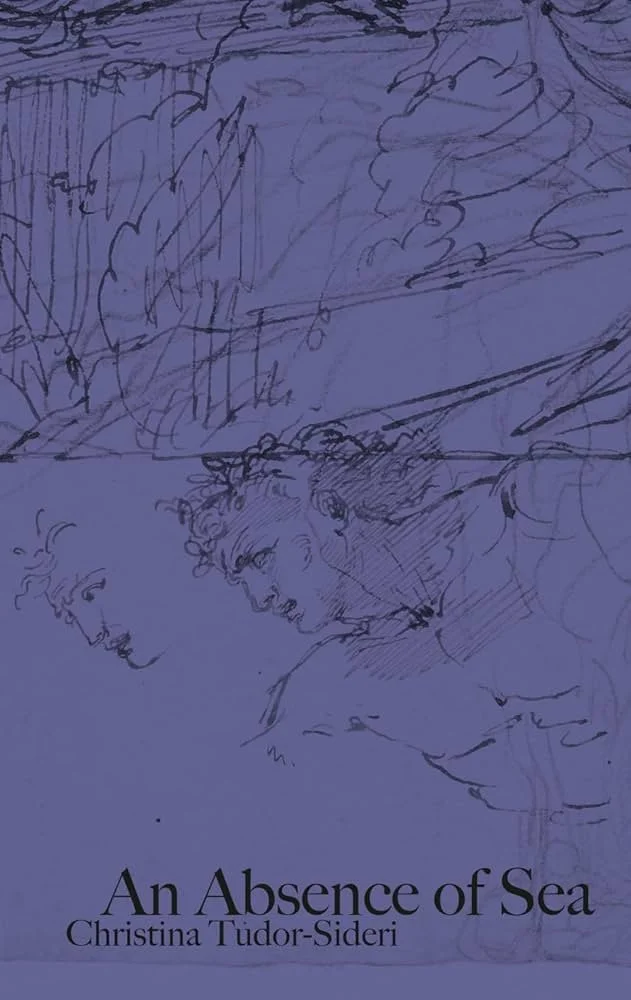
This arrives early in the pages of Christina Tudor-Sideri's An Absence of Sea—117 pages, a single unpunctuated address, published by Erratum Press—and it is in this warmth surviving the interval that we glimpse the book's theology in miniature. What is often called presence, Tudor-Sideri will spend a hundred pages proposing, is the warmth that stays in the ruin after the body, the lover, the moment now only attached to memory and feeling, has gone. This is both the concern of the book and the material of which it is crafted. The passage of the wall will be joined by many others that reach at the same condition, and in between are passages that substitute a deposit of names where an image may have been. Yet even the names alluded to or addressed directly throughout the book are ruins, a wall the prose presses against; some are warm, some are not; what Tudor-Sideri has understood is that the names themselves are ruins, and ruins are what we are left to work with, think with, write with.
The method wants describing, and it may be helpful to do so through the names gathered. There are no chapters, commas, full stops, headings; just paragraphs, white space, moments of breath. We are reading écriture féminine in the technical sense Cixous gave the term. The text flows in a continuous unpunctuated address to you: reader with book in hand, yes, but also to a beloved, to Maurice Blanchot, to his Thomas and his tragic double Anne, to her own double, to her grandfather, to fleeting literary figures to Albertine and Beatrice to Ava Klein and Emma Bovary to unnamed narrators and forgotten characters always vanishing before one could truly hold them in memory [she] write[s] to lovers in books who like ourselves are always searching always reaching always touching at the very edge, to letter writers, poets, philosophers, to no one, to the void.
Many names and allusions appear, and whether we know the name may be irrelevant. What we need to know and feel will be provided by what couches the name, in the images and ideas the prose offers, and if the reference alters anything, it will be clear in the effect on the writing.
…I write letters to other letters long meandering through the epistolary history of the world in search for just the right you for just the right way to address you now my love I write now when there is no distinction anymore between my body and theirs flesh and bone bodies literary bodies art museum pieces bodies of lovers of doubles…
We are also reading her in dialogue with the names given. With the Blanchot of writing pure interval in Awaiting Oblivion and in The Space of Literature as the space of dying which sits behind the words Tudor-Sideri writes; she names her first encounter with it, September 1999, at thirteen, as the moment from which all her sentences have come. And with the Marguerite Duras for whom the lover and the lover's absence had collapsed into a single object at the limit of speech. And with the shadow of Kafka, whose letters to Milena are directly referenced, whose letters are the form love can take, a writing that articulates distance without closing it, and it is this form of missive that Tudor-Sideri's own letter to the fluctuating you shares.
This work also shares the territory Tudor-Sideri has been circling in so many of her past books, variations on approaches to a cracked wall holding some warmth. Under the Sign of the Labyrinth, a book-length essay, took up the structural entanglement of myth, deferral, and the ephemeral—the labyrinth as a figure for the writing that never arrives. Disembodied and Schism Blue, both novels, staged the dislocation of the self across nonlinear temporalities. If I Had Not Seen Their Sleeping Faces, a collection of fragments, pressed closer still—presence, witnessing, the mnemonic trace in the face of death. Alongside these, she has been translating writers who are themselves writers of the wounded and the dissolved: Max Blecher, Magda Isanos, Ilarie Voronca, Mihail Sebastian. And now: An Absence of Sea, the flowing address in which form has been stripped to its barest gesture, a reaching out to find something in what remains.
Tudor-Sideri reaches out not just to thinkers and writers, but to artists, to images.
Arnold Böcklin appears early, invoked by atmosphere: the blurred brushstrokes of something like an Arnold Böcklin painting give the illusion of a world neither stable nor distinct already in the act of its own disintegration a world of voices and echoes the murmuring of beings. What Tudor-Sideri has seen in Böcklin is what he painted across multiple versions of Villa by the Sea: a woman standing alone beside a ruined coastal villa, the classical architecture of a villa crumbling into the sea behind her, the wind shifting her dress, without narrative to tell us what or who she has lost, there to bear witness. Tudor-Sideri's narrator is this woman. She stands beside what crumbles and does not leave.
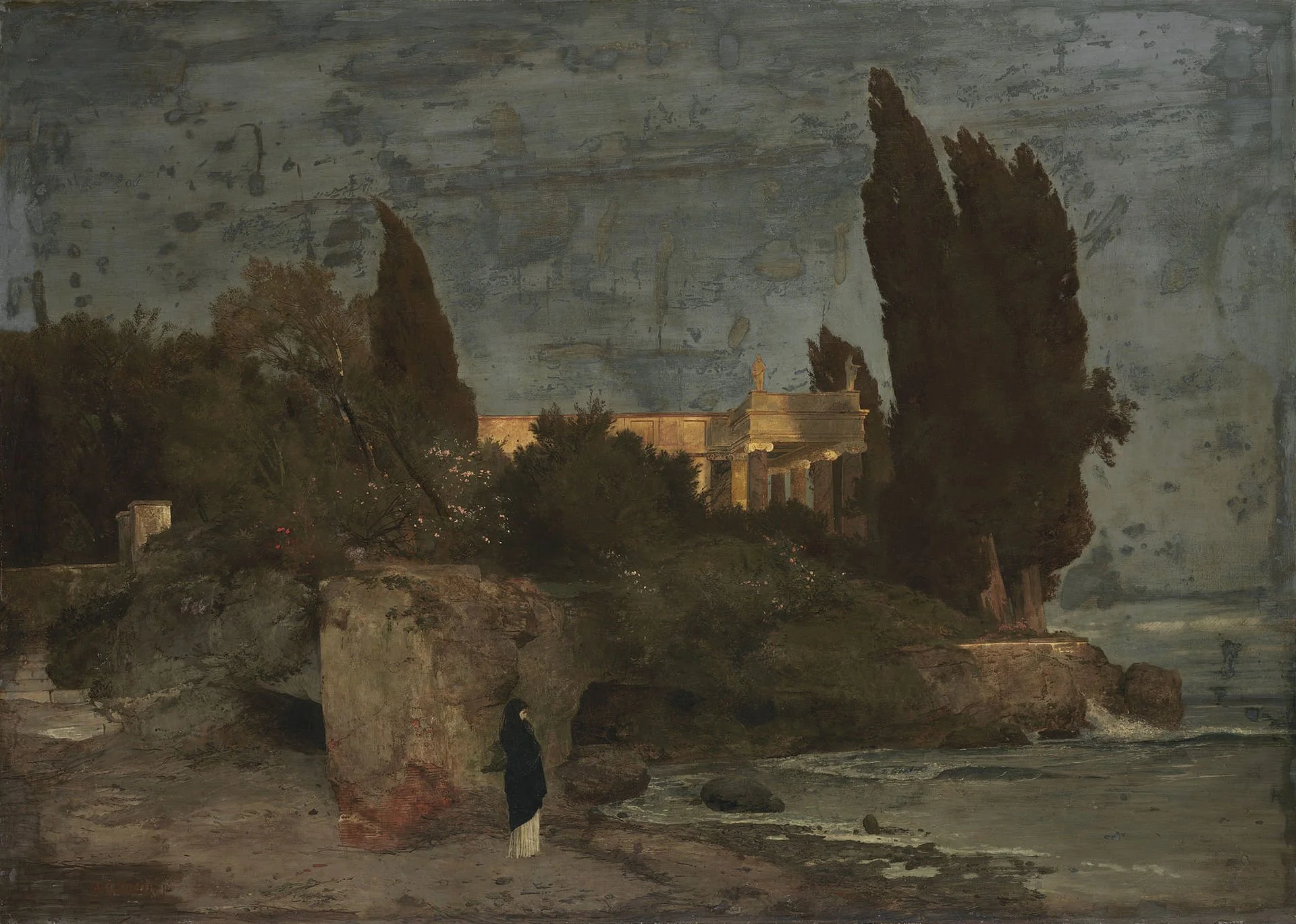
Villa by the Sea (1864)
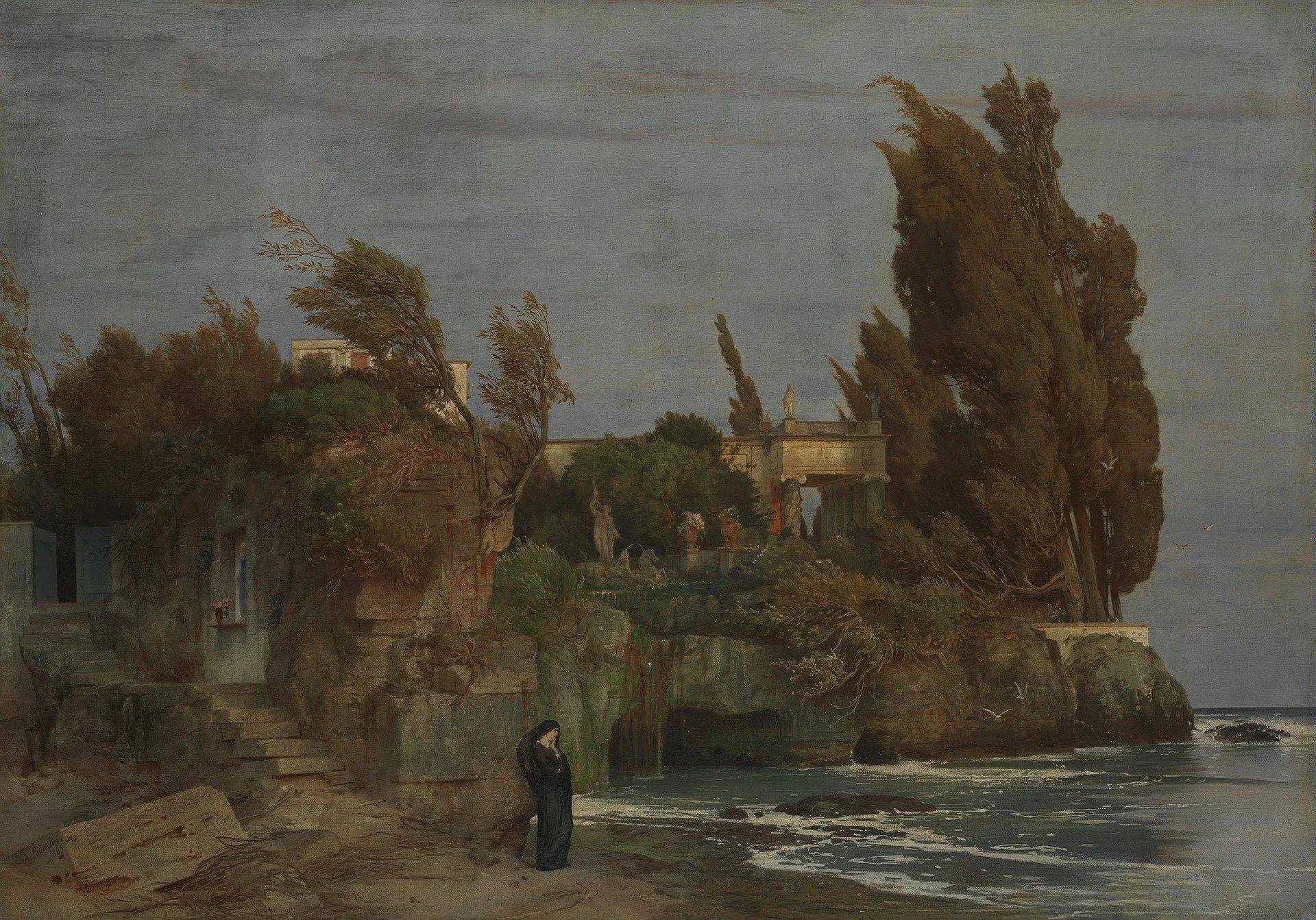
Villa by the Sea (1865)

Villa by the Sea (1871–1874)
Hubert Robert, the French painter of sublime demolitions, receives a direct reference. Tudor-Sideri describes his crowds who watch a church fall: still crowds linger not in mourning but in witness they watch the slow erasure of what once housed the innocent the air thick not with smoke but with absence. The witnessing crowd that does not mourn is a crucial image because it names the posture proper to ruin, which is one that demands attention and an allowance to let the dissolving be. Tudor-Sideri's narrator is one of those in the crowd, standing at the wall, at the cemetery, at the edge of the sea, attending to the falling away.
Another painter who returned his attention to ruins was Caspar David Friedrich and his rendering of Eldena Abbey across several canvases, its walls depicted in various stages of return to earth. Tudor-Sideri reads these remnants as openings: what is a ruin if not a form of remembering that refuses to solidify a slow collapse into stillness where the sacred no longer resides in structure but in air in light in moss covered silence. The sacred does not depart when the walls fall; it rises, clarifies. Freed from the architectural weight that held it, the opening in the walls is where the sky enters, the fallen structure is the condition of the encounter.
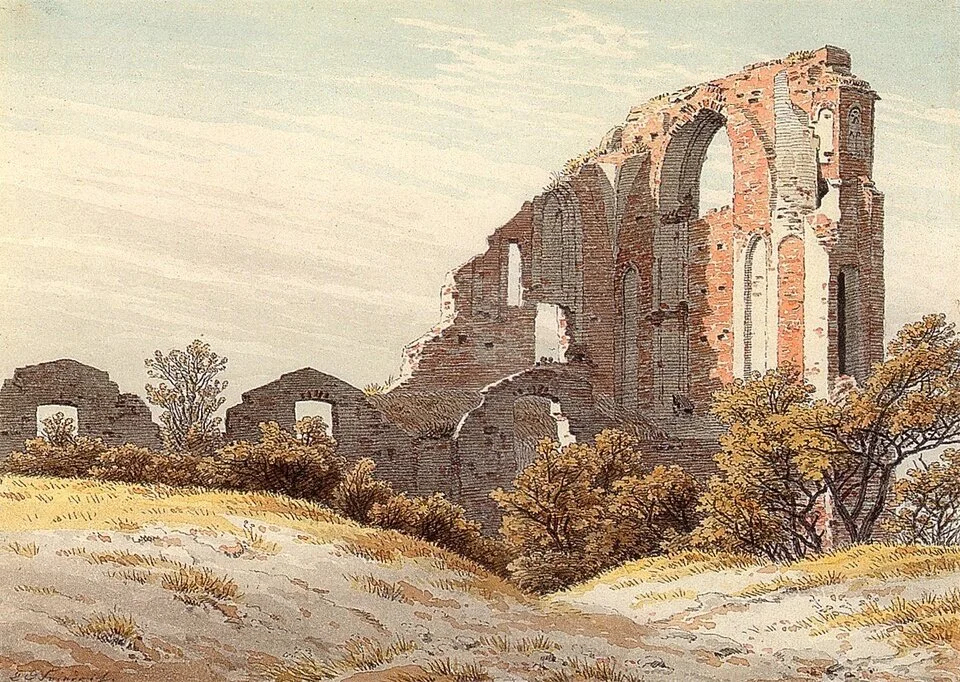
The Ruins of Eldena (1825)
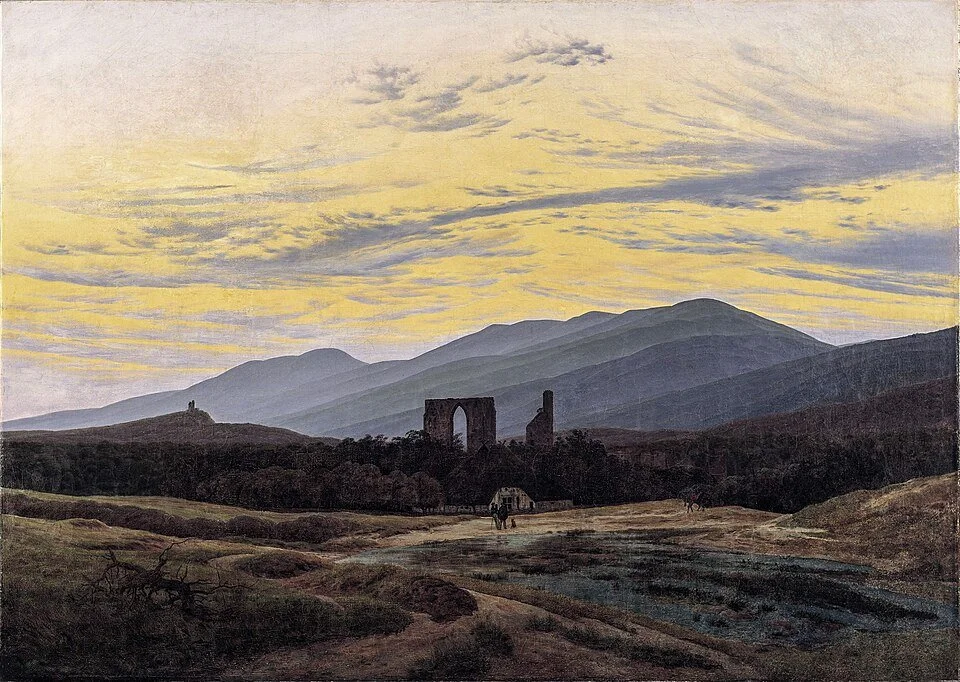
Ruins of Eldena Abbey in the Riesengebirge (1830-1834)
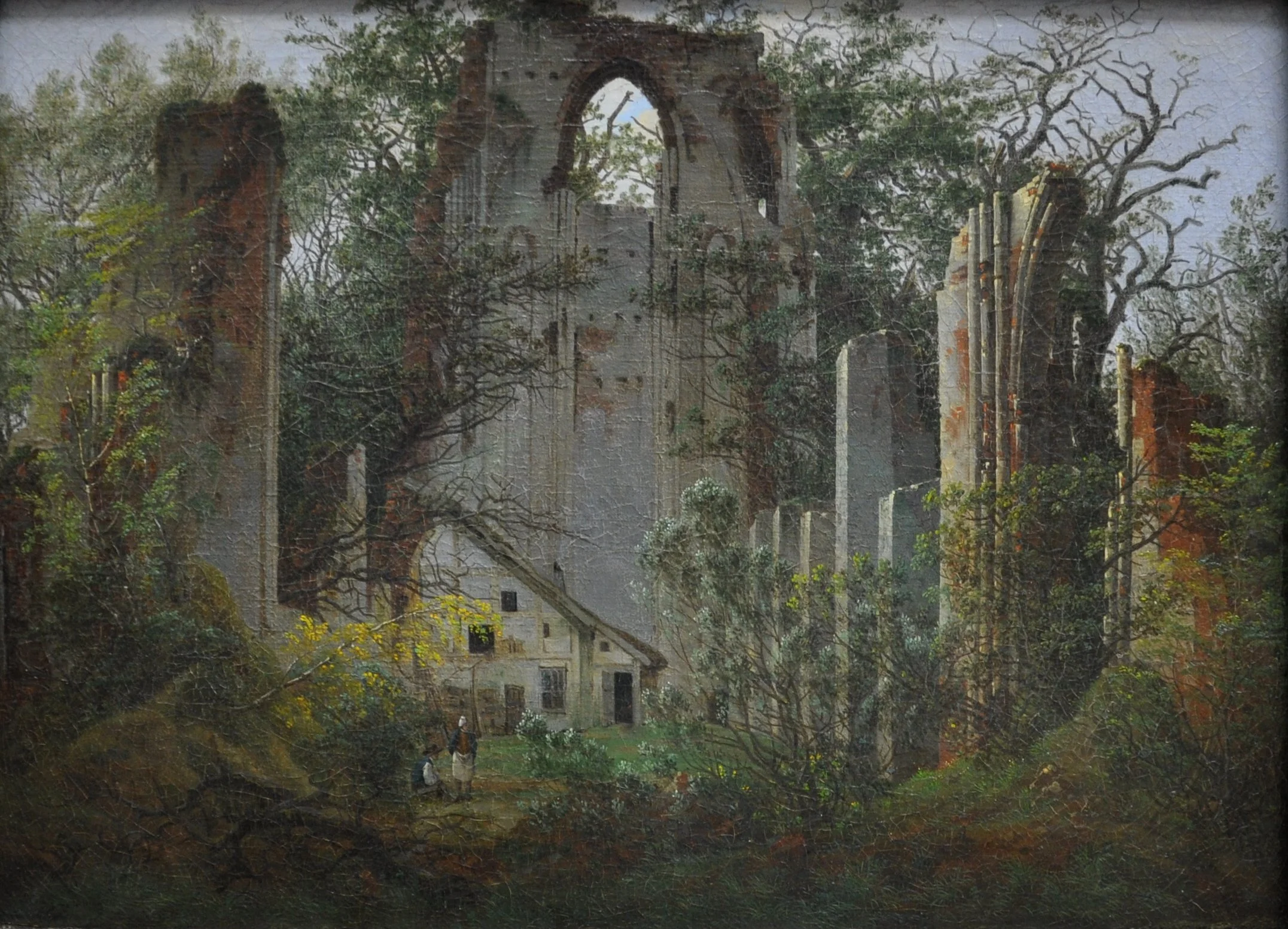
Ruins of Eldena Monastery near Greifswald (1824/1825)
Apophasis is the name for this. But not of the ironic variety. This is the via negativa, the naming of the divine by saying what God is not, an address possible for that which exceeds address. This is the language of mystics and sages and early Christian Neoplatonists and their inheritors whom Tudor-Sideri, writing within this lineage, converses with through the book's pages. Blanchot's The Space of Literature is an apophatic theology of the literary work, approached by way of the death the work can neither contain nor evade. Cixous's body-writing is an apophasis of the female subject, written by way of everything the masculine sentence cannot. Derrida's différance is apophasis with God removed and the structural negation kept. Kafka's letters to Milena are apophatic love-writing, the beloved approached only by the distance that makes approach impossible. The apophatic and the ruined are bound together. To approach a thing by way of what it is not is to gather what is left of it after the thing itself has gone, in fragments, traces, the warmth in a wall, the warmth of a body departed, the gauze of half-memory, the absent beloved, the walls of stone crumbling into the sea, time slipping by, the soul lingering obliquely. An Absence of Sea moves among and gathers these absences.
The ruins are not all equally cold. Some still hold the warmth of the thinking that built them. E.M. Cioran, not one usually associated with warmth, is one of these. His definition of time as lésion, the wound that cannot be erased, marks the flesh of Tudor-Sideri's meditation on the temporal. Cioran's work was an apophatic theology written in the absence of the God whose absence it kept addressing; he could not believe and could not stop missing what he could not believe in, and he made the wound a part of all his writing. Tudor-Sideri inherits the wound and the form of address required.
My love, Tudor-Sideri writes, and my love again, and my love again, recurring across the book with the frequency and insistence of the tide. The beloved is never named. Tudor-Sideri quotes Derrida's On the Name with characteristic seamlessness: I do not name you because the name would draw a border around the infinite would give face to the faceless trace and what I need is the tremor to lose the name is quite simply to respect it writes Jacques Derrida. Naming fixes and closes. In the repetitions of my love, Tudor-Sideri keeps the wound of non-naming open so that what lived in the wound can continue to live. The my love that organizes the book is fidelity to the refusal to close the distance that constitutes the beloved as beloved, the refusal to convert what cannot be held into what can be. Close the wound and what lived in it is lost.
…she goes where I cannot she stands among the weathered stones not endings but thresholds she says we remain travelers you and I how gently she speaks to him as if his sorrow were her own not inherited but shared a communion of unrest and vision I see her in that dream not mourning but talking quietly…
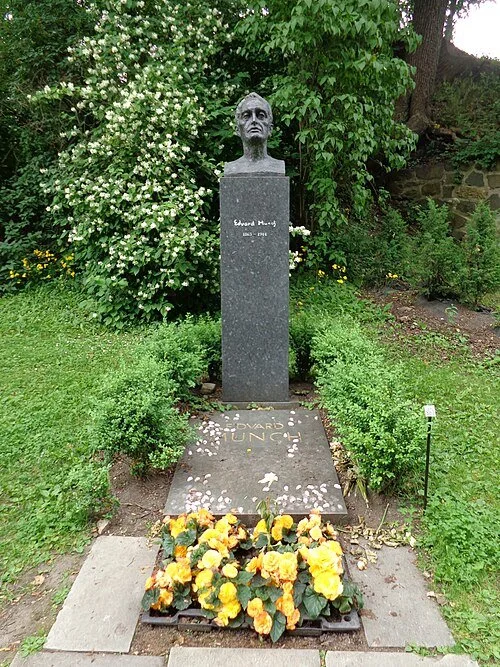
grave of Edvard Munch
In the middle of the book, Tudor-Sideri's double walks into Vestre cemetery in Oslo and speaks with Edvard Munch. From his rotting body flowers have grown. The double says, we remain travelers you and I, and Tudor-Sideri, watching her double, wonder[s] who the you is whether it is I or you or him or something else entirely the part of us that never arrives. Munch, who depicted his sister’s death many times throughout his life, questioned what the dead leave in the living and what the living owe the rotting body. And the flowers, one of the oldest images of grief, are already there, growing out of it. The dead nourishing the visible world. Tudor-Sideri sets it down without comment, without a Heideggerian arrival to burnish it, without trembling at the threshold to insulate the line. Presenting the dead painter through this image of the body that no longer is and the flowers that are, is apophatic work.
Just prior to this it is a perfume—l'air de rien, neroli, old books dust touched skin—that the double, the dreamer, within the letter has traveled to London to find. The image is smaller than the wall or the cemetery, but reaches toward and gathers some of what those other moments do: the trace of a body through the only material that survived the body's passing.
When Tudor-Sideri is writing in this way, she does not merely phenomenologize absence; she finds a specific vessel: the warm wall, the rotting body sprouting flowers, the perfume the dreamer travels to London for. She lets the vessel hold what cannot be held otherwise. The names of the philosophers fall away because they are no longer needed. We are presented with a form of literary phenomenology that lives in the vessel and the image rather than in the theory and the argument.
Even moments that are self-aware. At one point the letter pauses inside its own procedure to ask the question the reader would ask of her—something human but how and why again I ask I have to explain myself better. Here, the method interrogates itself from within. Here, Tudor-Sideri briefly looks up from the wall to wonder whether her hand against it is still finding warmth or if it is, over time, only the memory of finding warmth. The hesitation does not last. The procedure resumes. One wishes for a longer pause, but Tudor-Sideri's voice is more continuous, more tidal. It does not stop, because stopping would close the wound.
A similar moment occurs late in the book when Tudor-Sideri addresses the reader who might see only incoherence. Someone else, she writes, might see in all this only confusion, only speculation, only the incoherence of a mind unraveling. Every philosophical system, she answers, is already a cathedral in ruin, with its foundations seething with contradiction. To think, then, is a kind of unbuilding, to practice what she calls a poetics of fracture, a way of saying the unsaid. This is the book's own account of its method, given from inside.
…someone else anyone else might see this as an ontological quest a plunge into the chaotic heart of being they might see only confusion only speculation only the incoherence of a mind unraveling but still continuing perhaps in darkness perhaps at midnight perhaps when midnight means nothing because sometimes time slips away loses its grip becomes irrelevant and in such a moment someone says she has awakened not gently but violently torn from some terrible dream she revolts she rises she resists not just the world but the narratives the names the meanings she has been given and she begins again begins to tell herself anew or perhaps unmake herself in fragments…
In the book's final movement, Tudor-Sideri turns to an image of boats. Ancient, Greek, the kind that carried gods and men and olives across the Aegean. If I speak now of boats of dreaming boats it is not to locate history but to remain near it to move with it not forward but along its edges as if memory were maritime and the past a coastline we never quite land upon only drift beside. Memory as maritime, the past as coastline one does not land upon, the apophatic relation to time given as image: the approach that is never arrival, the attention that refuses to seize what it attends to, nearness as the only form of contact available. We cannot recover the past; instead, we drift beside its coastline. Tudor-Sideri's prose moves this way through the whole book: along the edge of what it cannot enter.
What An Absence of Sea does is what it says of itself on its last page. The apophatic, Tudor-Sideri writes—the word that has shaped this essay, and the word that, surfacing only three times across the book, names what she has been doing all along—everything that lives in my mind I place it here I give it to you my absent one. Again: a vessel, one in which everything that lived in the mind has been set down. The wall, the cemetery, the perfume, the boats, each placed, each given, each gathered, each held out to a reader who is both present in the moment of reading and also the absent one, who is every absent one—this is the work’s thesis, glimpsed in the warmth of the stone, now arrived at its full articulation.
And in its final breath, after a long passage on how we devour the other, the dead, the time that was, and the time to come, Tudor-Sideri writes a sentence and lets it stand alone:
and this too we devour
This book, this letter, has built—out of what remains—its own disintegration. And we are left with the dimming warmth of having read it.